
What is neuromarketing?
Neuromarketing is the use of neuroscience, behavioural science and research methods to understand how people respond to brands, messages, products, services and experiences.
It can help measure response patterns beyond what people can always explain in words.
Neuromarketing does not read minds or reveal a hidden buy button. It needs careful research design, context and interpretation.
Not sure which method fits your question? Start with the research question →Neuromarketing is useful when you need to understand response patterns, not only stated answers.
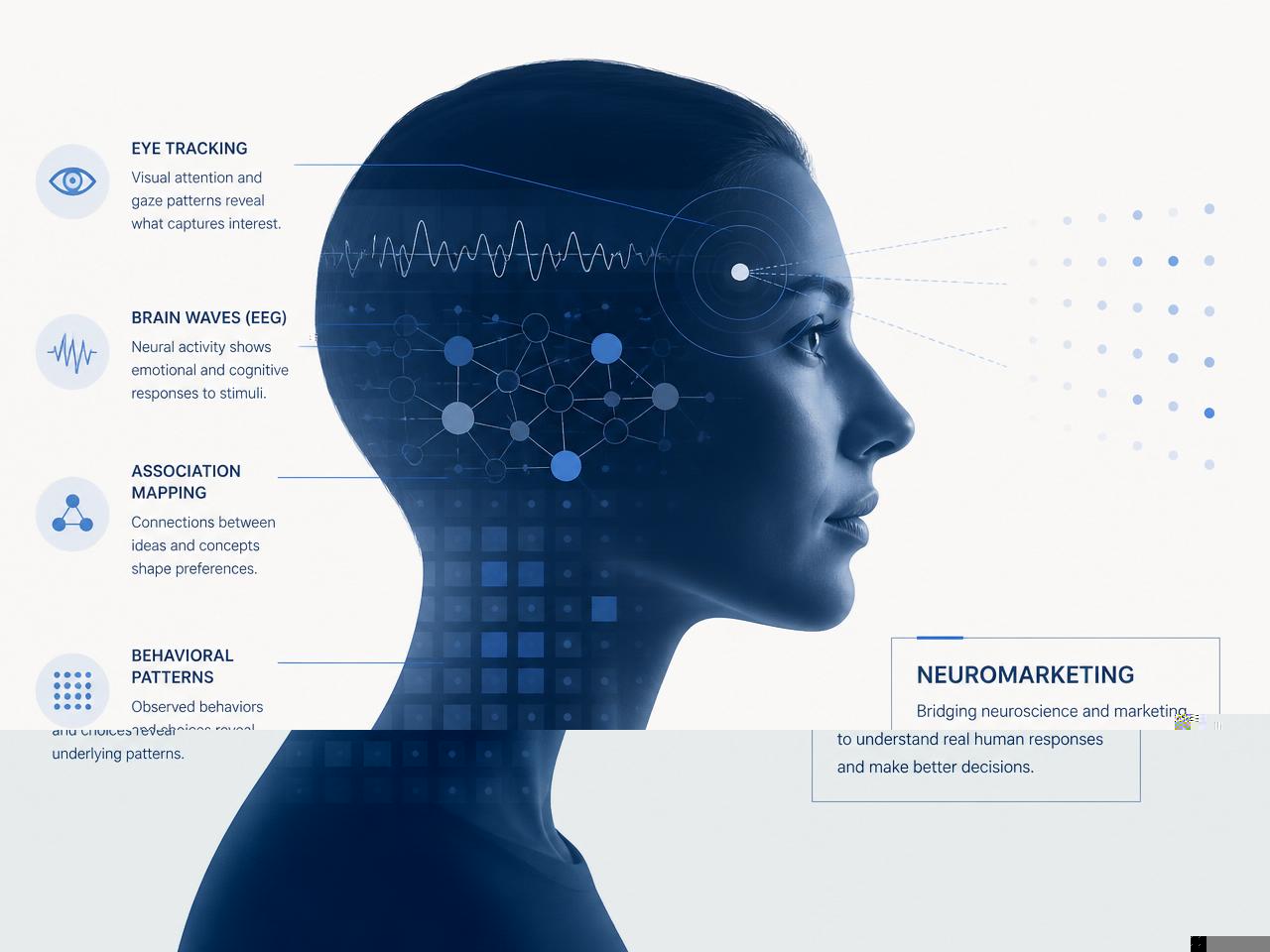
Neuromarketing helps measure how people respond.
Neuromarketing combines neuroscience, behavioural science and research methods to understand how people respond to brands, messages, products, services and experiences. It can include methods such as EEG, eye tracking, implicit association research, behavioural research, surveys, interviews, fNIRS, fMRI and data strategy, depending on the research question.
Neuromarketing can help measure attention, visual attention, response patterns, associations, processing, friction and behavioural context. It does not read minds, prove exact emotions, reveal a hidden buy button or predict behaviour with certainty.
Neuromarketing is not about replacing what people say. It is about adding another layer to understand how people respond.
What is neuromarketing?
Neuromarketing is the use of neuroscience, behavioural science and research methods to understand how people respond to brands, messages, products, services and experiences.
In practice, neuromarketing can combine brain measurements, eye tracking, implicit association tests, behavioural data and traditional research to study how people process marketing, make decisions and respond to stimuli.
Neuromarketing is not one single tool. It is a field of applied research in which different methods are selected based on the research question.
The goal is not to read minds. The goal is to understand response patterns that can support better decisions.
What does neuromarketing measure?
What neuromarketing measures depends on the method, the research design and the question being asked. Common measurement layers include:
Attention patterns
Where and how attention is captured, held or lost.
EEG, eye tracking, behavioural data
Visual attention
Where people look, what they miss and how gaze moves.
Eye tracking
Response timing
How fast people respond and how that changes over time.
EEG, behavioural data, RIAT
Engagement-related patterns
How processing develops while an experience happens.
EEG, fNIRS, behavioural data
Approach/avoidance
Whether response patterns lean toward engagement or withdrawal, depending on setup.
EEG, fNIRS, behavioural data
Implicit associations
Which automatic connections activate between concepts and attributes.
RIAT, implicit association research
Brain response patterns
Neurodata patterns related to processing of stimuli.
EEG, fNIRS, fMRI
Decision friction
Where hesitation, confusion or effort appears in a journey.
Eye tracking, EEG, behavioural data
Message perception
How a message is noticed, processed and associated with meaning.
Eye tracking, EEG, RIAT, surveys
Experience processing
How an experience is processed during the moment itself.
EEG, fNIRS, eye tracking, behavioural data
Behavioural context
How findings relate to real behaviour and business data.
Behavioural data, profiling, business data
What neuromarketing measures depends on the method, the research design and the question being asked.
What people say is useful. It is not always complete.
Surveys and interviews are valuable because they show what people can explain, remember and consciously report.
But people do not always notice what influenced them. They may not remember how they processed a message, why a design created friction or which associations were activated by a brand or product.
Neuromarketing can add another layer by measuring response patterns during or close to the experience itself.
Neuromarketing helps compare what people say with how they respond.
From what people say to how people respond.
- What people say
- What they remember
- What they consciously prefer
- What they explain afterwards
- What they report in surveys or interviews
- Where people look
- How they respond over time
- Which associations activate
- Where friction appears
- Which message or experience is processed differently
- How findings compare with behaviour and business data
The most useful insight often appears when stated answers and response patterns are interpreted together.
Common neuromarketing methods.
Neuromarketing is not one tool. It is a research approach that may include different methods, selected per question.
EEG
Fast response patterns and processing over time.
The research question is about how people process an experience while it happens.
Eye tracking
Where people look, what they miss and how visual attention moves.
The research question is about attention, visibility, design hierarchy or visual friction.
Implicit association research / RIAT
Automatic association patterns between concepts and attributes.
The research question is about what people automatically connect with a brand, message, profile, product or category.
fNIRS
Changes related to brain oxygenation, depending on the setup.
The research question needs another neurodata layer related to brain oxygenation.
fMRI
Deeper brain measurement patterns in controlled academic research setups.
The research question justifies deeper controlled brain measurement.
Behavioural data
What people choose, click, ignore, abandon, repeat or act on.
The research question needs a link between perception and real behaviour.
Surveys and interviews
What people can explain, remember and consciously report.
The research question needs conscious evaluation, reasons, language or self-reported preference.
Profiling and data strategy
Connection of different data layers into decision-ready interpretation.
The team needs to translate research, neurodata, business data or behavioural data into strategy.
The right neuromarketing method depends on the research question, context, data quality, ethics and decision that needs support.
What neuromarketing can measure, and what it cannot prove alone.
- Attention patterns
- Visual attention
- Response timing
- Engagement-related patterns
- Approach/avoidance patterns, depending on setup
- Implicit association patterns
- Brain response patterns
- Decision friction
- Message perception
- Experience processing
- Behavioural context
- Thoughts
- Exact emotions
- Truth
- Purchase intent
- Future behaviour
- A hidden buy button
- Manipulation potential
- Conversion guarantee
- Individual-level certainty
- Medical diagnosis
Neuromarketing findings should be interpreted in relation to the research question, method setup, target group, stimuli, context and supporting data.
Neuromarketing can add evidence. It is not a shortcut to certainty.
What is neuromarketing used for?
Neuromarketing supports decisions wherever response patterns matter, not only stated preference.
Brand research
Which associations and response patterns are connected to the brand?
RIAT, EEG, surveys, behavioural data
Message testing
Which message is noticed, processed and associated with the intended meaning?
Eye tracking, EEG, RIAT, surveys
Campaign optimisation
Which creative direction performs better in attention, processing and association?
Eye tracking, EEG, behavioural data
Product and concept research
How do people respond to a new product, packaging or concept?
Eye tracking, EEG, RIAT, surveys
UX and customer journey
Where does friction appear and where is the journey clear?
Eye tracking, EEG, behavioural data
Pricing and value perception
How is price processed in relation to perceived value?
EEG, RIAT, surveys, behavioural data
Retail and environment
How do people move through and respond to physical spaces?
Mobile EEG, eye tracking, behavioural data
Experience research
How is an experience processed while it happens?
EEG, fNIRS, eye tracking, behavioural data
Recruitment and employer branding
What does talent automatically associate with the employer and role?
RIAT, surveys, profiling
Behavioural intervention design
Which intervention is noticed, understood and acted upon?
Eye tracking, behavioural data, RIAT
Neuromarketing is useful when the decision depends on response patterns, not only stated preference.
Neuromarketing vs traditional market research.
Neuromarketing is an addition to traditional research, not a replacement.
- What people say
- What they remember
- What they consciously prefer
- Why they say they made a choice
- Language and explanation
- Market sizing
- Self-reported attitudes
- Visual attention
- Response timing
- Processing patterns
- Automatic associations
- Friction signals
- Experience response
- Comparison with behavioural data
The strongest research often combines what people say, what they do and how they respond.
Is neuromarketing ethical?
Neuromarketing should be used to understand people better, not to manipulate them.
Responsible neuromarketing requires clear research design, informed consent, privacy protection, GDPR-aware data handling and careful interpretation of results.
The goal is to improve decisions, communication, products and experiences with better evidence.
- Neuromarketing should not be used to claim mind-reading.
- Neuromarketing should not be used to manipulate vulnerable groups.
- Neuromarketing should not be used to make medical or psychological diagnoses in marketing research.
- Neuromarketing should not be used to predict individual behaviour with certainty.
Ethical neuromarketing starts with a responsible research question.
How Neurofactor uses neuromarketing.
Neurofactor starts with the decision the research needs to support.
From there, the team determines which methods are useful, which data layers are needed, which target groups should be included and how findings should be interpreted.
The result is not just data collection. The result is decision-ready interpretation for marketing, product, brand, recruitment, workplace or experience questions.
- 1Define the research question
- 2Define the decision
- 3Select the target group
- 4Select the method stack
- 5Design the stimuli and research setup
- 6Collect data responsibly
- 7Interpret findings in context
- 8Translate results into recommendations
- 9Connect to strategy, product, communication or experience decisions
Neurofactor uses neuromarketing as a decision-support layer, not as a promise of hidden truth.
Neuromarketing methods you can explore.
Neuromarketing is not one method. The right method depends on the question.
EEG measurement
Measure how people process experiences while they happen.
→Real-world EEG / mobile EEG
Measure brain response where the experience happens.
→Eye tracking
Measure what people look at, miss and visually prioritise.
→fNIRS research
Add brain oxygenation data to your neuro research setup.
→fMRI research
Add deeper brain measurement to complex research questions.
→Implicit association research / RIAT
Measure automatic association patterns.
→Profiling and data strategy
Turn market, business and brain data into strategy.
→Where neuromarketing can be applied.
The same methods can support different decisions depending on the context.
Want to know which neuromarketing method fits your question?
You do not need to know whether EEG, eye tracking, RIAT, fNIRS, fMRI or another method is the right fit yet. Start with the research question. Neurofactor can help define the method stack, target group and interpretation framework that fit the decision you need to make.
Neuromarketing is useful when you need to understand response patterns, not only stated answers.