
Why real art moves the brain differently
What happens when people stand face to face with a world-famous masterpiece? For the Mauritshuis, Neurofactor studied how visitors respond to the real Girl with a Pearl Earring and how that experience differs from looking at a reproduction.
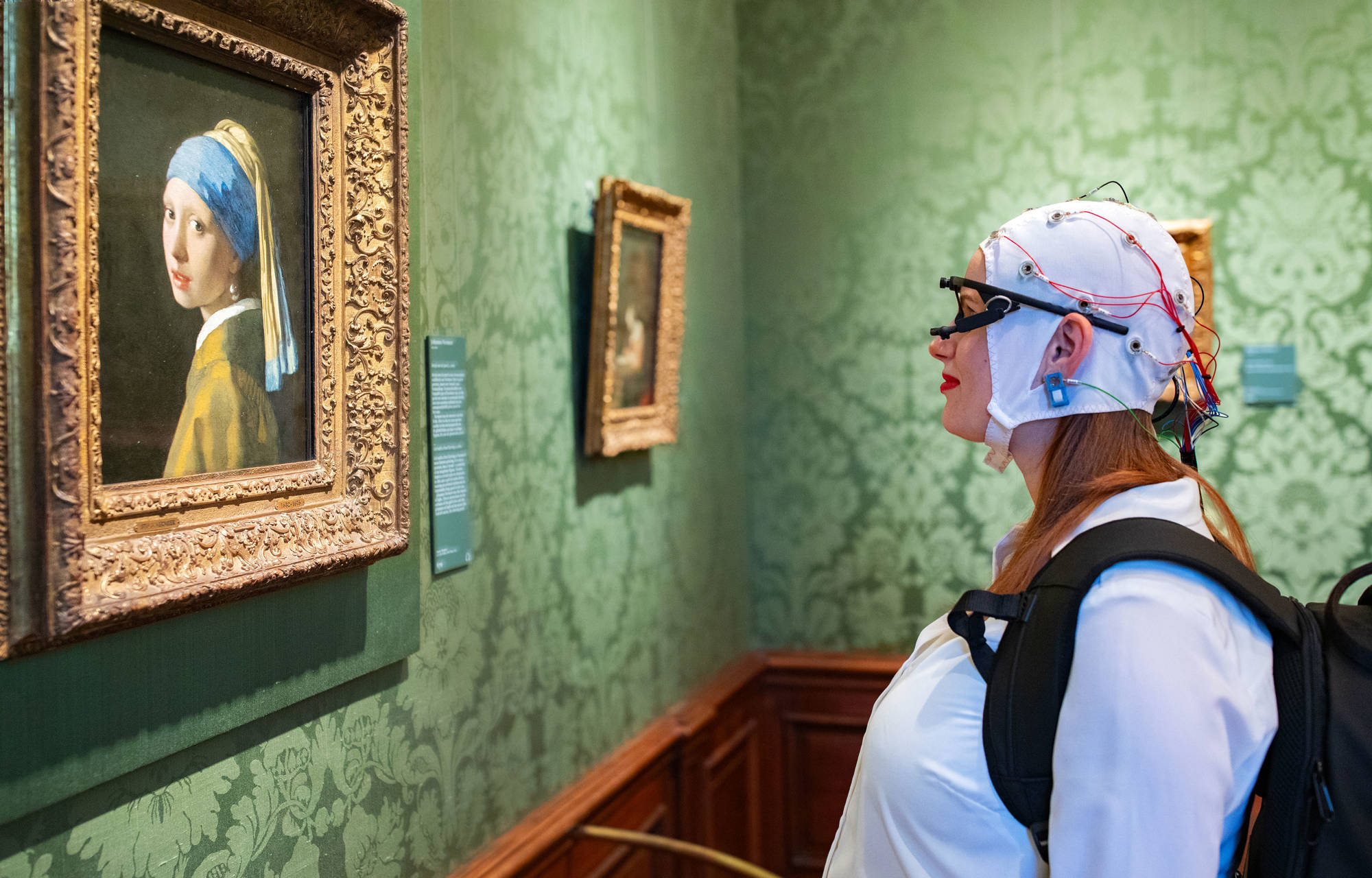

Watch the story behind the research
In this short video, Martijn den Otter explains what Girl with a Pearl Earring does to our attention and how Neurofactor studied it.
The case at a glance
Up to 10x stronger emotional response is the outcome reported within this study. It is not a general conclusion about the effect of museum visits on wellbeing.
The challenge
Can you measure the power of real art?
In early 2023 the Mauritshuis approached Neurofactor with a curious question. The museum wanted to know what actually happens to people standing face to face with Girl with a Pearl Earring.
- Which emotional response does Girl with a Pearl Earring evoke?
- Does that response differ from viewing a reproduction at the same size?
That created an unusual research problem. An original masterpiece cannot be brought into an fMRI scanner. The design therefore had to measure the real museum experience first and examine those findings in scanner research afterwards.
The approach
Measure in the museum first, then go deeper
The study was set up in two parts. First, what happens in the museum itself was measured. The strongest signals from those measurements were then examined further.
Participants viewed several original artworks in the museum. In a separate room they viewed reproductions of those same works at the same size.
The order in which participants saw the originals and the reproductions was alternated, making the comparison between both situations fairer.
EEG recorded the brain response while participants looked. Eye tracking showed which parts of the painting were viewed and how the gaze moved. Combining both linked viewing behaviour to the measured response.
The museum findings were then examined further using fMRI and eye tracking.
fMRI showed which brain regions and systems became active during the experience. Eye tracking showed where participants were looking at any given moment.
Combining both measurements allowed the viewing pattern to be linked to the underlying response.
From phase 1 to phase 2
Two signals that called for more depth
The museum measurements revealed two things that warranted further study.
- Within this study, original art evoked a much stronger emotional response than reproductions.
- Girl with a Pearl Earring held attention exceptionally strongly.
What makes this particular painting hold our attention so powerfully?
The findings
An encounter that keeps holding attention
Within this study, viewing original art produced a considerably stronger emotional response than viewing reproductions at the same size.
Girl with a Pearl Earring held participants' attention notably strongly, more so than the other works in the study.
Because viewing behaviour and brain response were measured at the same time, it became visible how visual attention and emotional response came together within the same experience.
Within this study, viewing original museum art produced an emotional response measured as up to ten times stronger than viewing reproductions at the same size.
That result applies to the comparison within this study and is not a general measure of the effect of every museum visit.
The central insight
Eyes, mouth, pearl - and again
Participants did not simply scan the face once. Their gaze moved repeatedly between the eyes, the mouth and the pearl.
The gaze kept moving between three points in the face. It is that recurring pattern that helped explain why the painting does not only draw attention, but keeps holding it.
The methods in brief
What exactly was measured
EEG records electrical activity at the outside of the head and was used here to follow changes in brain response while participants looked.
Eye tracking records where someone looks, in which order, and how long particular elements hold attention.
fMRI measures changes in blood flow associated with brain activity and was used to examine the response in more depth.
What it means
The value of art emerges in the real encounter
The research showed that the experience of an original artwork is not fully reproduced by an image at the same size. This is an insight from this specific study.
- Within this study, the original and the reproduction did not evoke the same response.
- Girl with a Pearl Earring produced a distinctive pattern of sustained visual attention.
- Combining measurements in the museum with in-depth scanner research made this visible.
Experience emerges in context. Asking only afterwards what people experienced misses part of what happens during the moment itself.
What it means for other organisations
Measure experience where it actually happens
Human experience is shaped by more than what people can report afterwards. Measuring brain response and visual attention in the real environment reveals how people truly experience art, spaces, products and experiences.
Which experience do you want to understand better?
From art and culture to products, environments and live experiences - Neurofactor measures human response at the moment the experience actually takes place.